Why the second location breaks everything
One location runs on shared context: everyone knows the techs, the trucks, and today's chaos. The second location destroys that ambient awareness. Suddenly a dispatcher books a Aurora tech for a Boulder job, revenue mixes into one indistinguishable pot, and the new branch manager either sees everything (bad) or nothing (worse).
The fix isn't heroic coordination — it's structure: location-aware jobs, phones, permissions, and reports.
Give every job a home branch
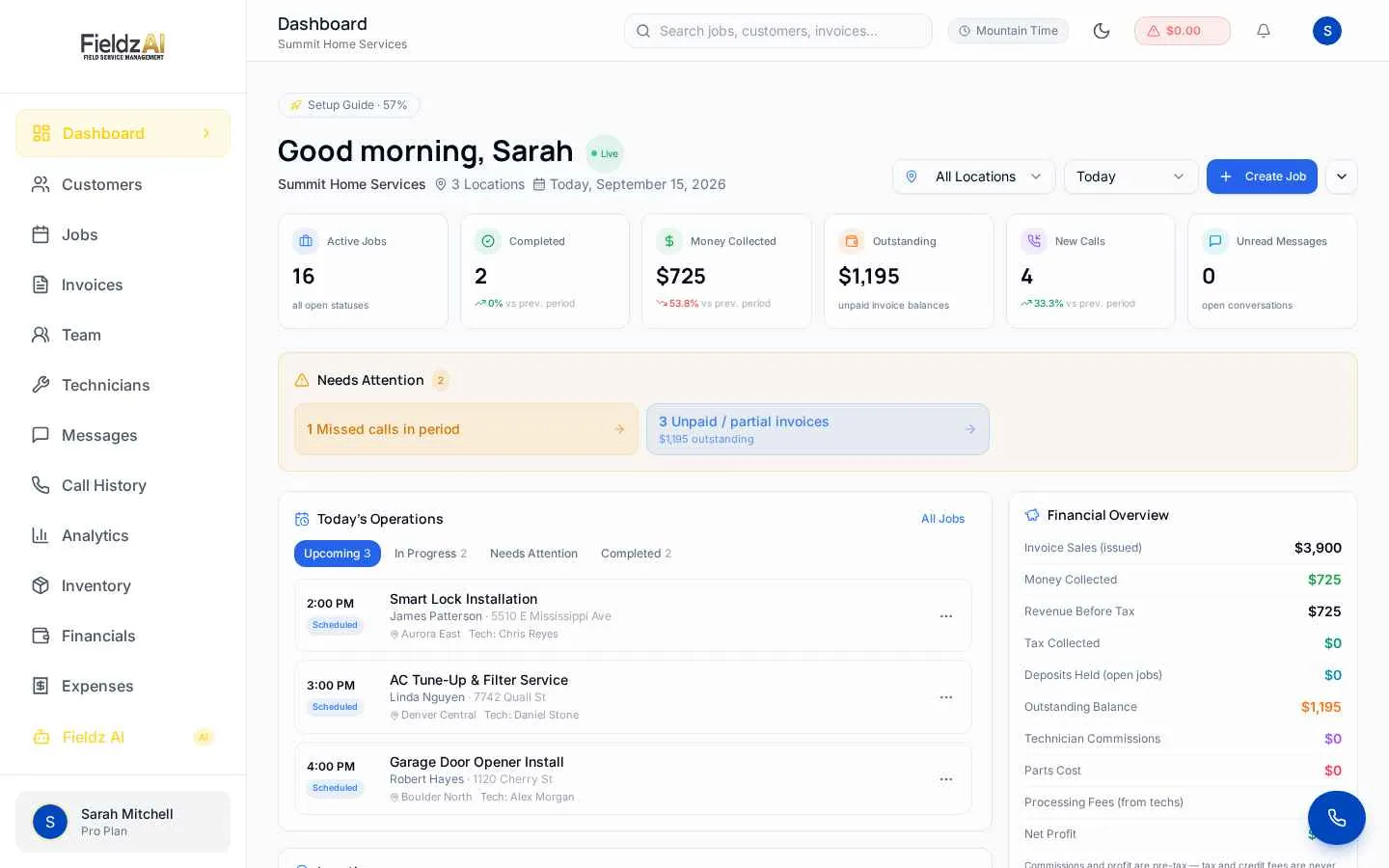
Every job should carry a location from the moment it's created, driving which technicians are eligible, which phone line confirmations send from, and which branch's P&L the revenue lands in. In Fieldz AI, multi-location accounts pick the branch right in the job form — with the default location prefilled so speed doesn't suffer.
Phone lines per location
Local numbers matter in local trades: customers answer local area codes and trust businesses that feel nearby. Provision a line per branch, route each line to that branch's team with business-hours rules, and keep after-hours calls flowing to voicemail or an on-call sequence. Every call still logs into one system, so ownership keeps full visibility.
Permissions: managers see their branch
Branch managers need full operational control of their location — and no ability to browse another branch's revenue. Location-based permissions solve the trust problem structurally: owners see the consolidated picture, managers see their slice, and technicians see only their own jobs.
Report both ways: rolled up and split out
Ownership needs two views that spreadsheets struggle to keep honest: the consolidated company view (total revenue, profit, outstanding balances) and the per-branch comparison (which location is growing, which is bleeding margin on parts). When both come from the same live job data, weekly reviews turn from data-gathering exercises into decision meetings.
Get these four structures right and the third and fourth locations become repetition instead of reinvention — the point at which a field service company becomes genuinely scalable.
Key takeaways
- Stamp every job with a home branch — it drives dispatch, phones, and P&L
- Give each location a local line routed to its own team
- Branch managers get their slice; owners get the consolidated view
Free download
Get the Field Service Pricing Guide
The 4 pricing models vendors use, a hidden-cost checklist, and a worksheet to calculate any platform's true monthly cost.
Instant download. No spam — unsubscribe anytime.