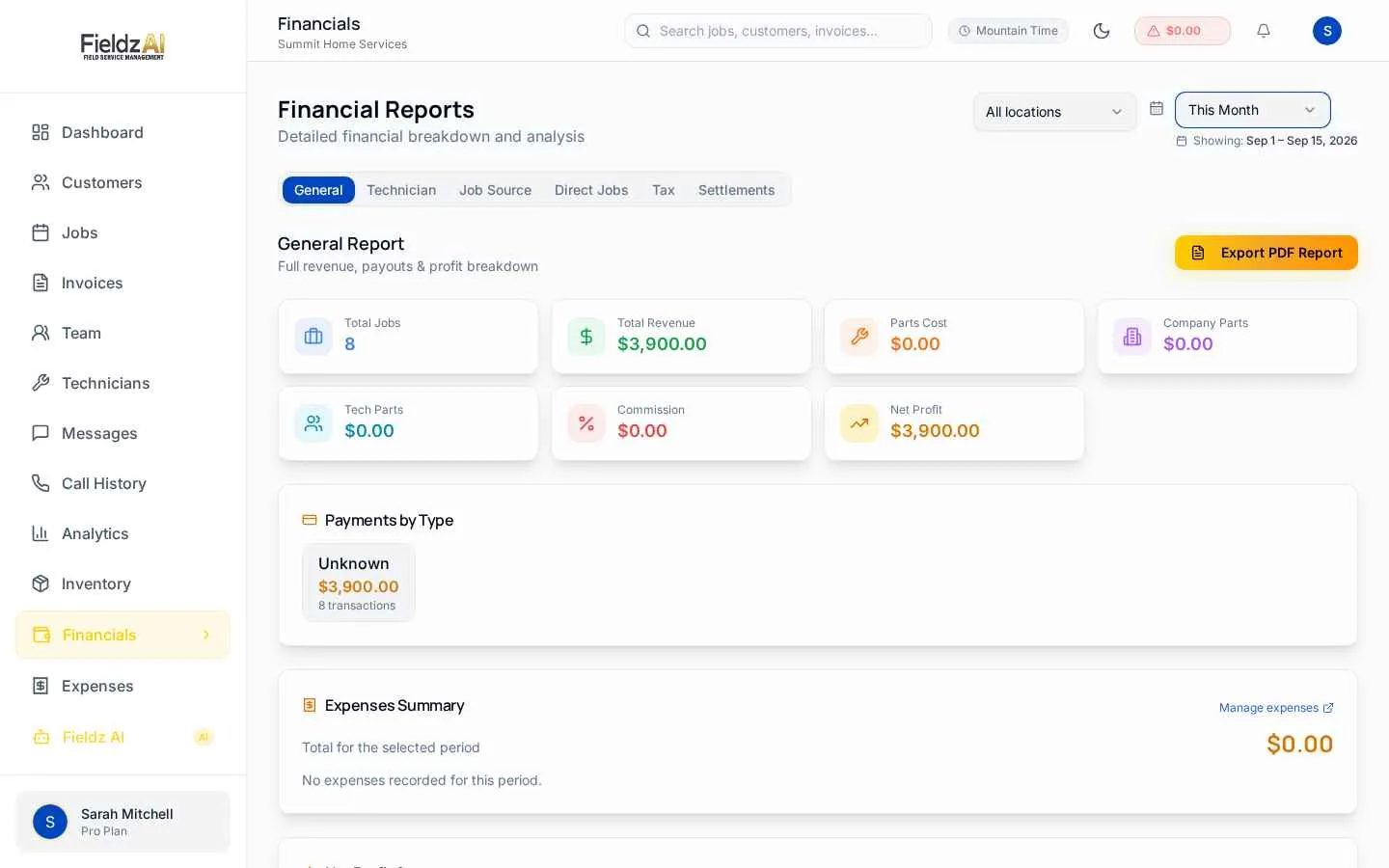
1. Job-level gross profit
Revenue per job minus parts, technician commission, and payment processing fees. This is the single most clarifying number in field service: two jobs with identical $600 tickets can net wildly different profit once a $220 part and a 40% commission enter the math. If you only watch top-line revenue, high-cost jobs hide inside good months.
2. Operating result (net of expenses)
Take your completed-jobs profit and subtract business expenses — fuel, insurance, software, rent. This is the money the business actually made. Tracking it weekly instead of discovering it at tax time lets you react while it still matters.
3. Technician commission liability
How much do you currently owe each technician? Businesses that track this in spreadsheets almost always discover discrepancies — missed jobs, double-counted bonuses, stale rates. A live owed-versus-settled ledger per tech removes the Friday-afternoon argument and the accounting risk at once.
4. Outstanding balance (accounts receivable)
The sum of sent-but-unpaid invoices. Watch both the total and its age: an outstanding balance that grows faster than revenue means your collection process, not your sales, is the bottleneck. Text-to-pay links and automatic receipt flows pull this number down fast.
5. Missed calls per week
In trades where customers call the next company when nobody answers, a missed call is usually a lost job. Count them. If the number surprises you, fix routing first — ring more people, add sequential fallback, extend business hours coverage — before spending another dollar on ads.
6. Revenue by lead source
Tag every job with where it came from: Google, referral, marketplace, repeat customer. Report revenue and profit per source quarterly. Most businesses find one channel quietly outperforming everything else — and one they're overpaying for.
7. Jobs per technician per day
The capacity metric. If one tech consistently completes four jobs a day and another two, the difference is route density, job mix, or coaching opportunity — all fixable once visible. Combine it with job-level profit to see who's producing, not just who's busy.
None of these require a finance degree — they require a system that records parts, commissions, fees, and sources on every job as it happens. That's exactly what integrated field service reporting is for.
Key takeaways
- Watch job-level profit, not just revenue — costs hide inside good months
- Keep commission liability and outstanding balances live, not monthly
- Missed calls and lead-source profit are marketing KPIs in disguise
Free download
Get the Field Service Pricing Guide
The 4 pricing models vendors use, a hidden-cost checklist, and a worksheet to calculate any platform's true monthly cost.
Instant download. No spam — unsubscribe anytime.