Start with your workflow, not feature lists
Every vendor's feature page looks similar. The real differences appear when you walk your actual day through the product: a call comes in — what happens? Can whoever answers see the customer's history instantly? How many clicks from that call to a scheduled, dispatched job? Write down your five most common workflows and evaluate against those, not against a checklist of 200 features you'll never open.
Count the systems you're replacing
The strongest ROI case for modern field service software is consolidation. If you're currently paying for a scheduling tool, a VoIP phone system, an invoicing product, and a review-request service, a platform that includes all four changes the math completely — before counting the hours saved on double-entry.
Ask specifically: is the phone system native or a third-party integration? Is SMS included or metered separately at painful rates? Are 'automations' actually included in the tier you'd buy?
Interrogate the pricing model
Three pricing traps recur across the industry. Per-user pricing that makes your tenth hire cost more in software than in tools. Feature-gated tiers where the thing you need is always one tier up. And add-on stacking, where the advertised price quietly doubles once phone, SMS, and portals are bolted on.
Prefer transparent public pricing, and calculate the true monthly cost for your team size with every capability you need turned on — not the teaser tier.
Check the money math
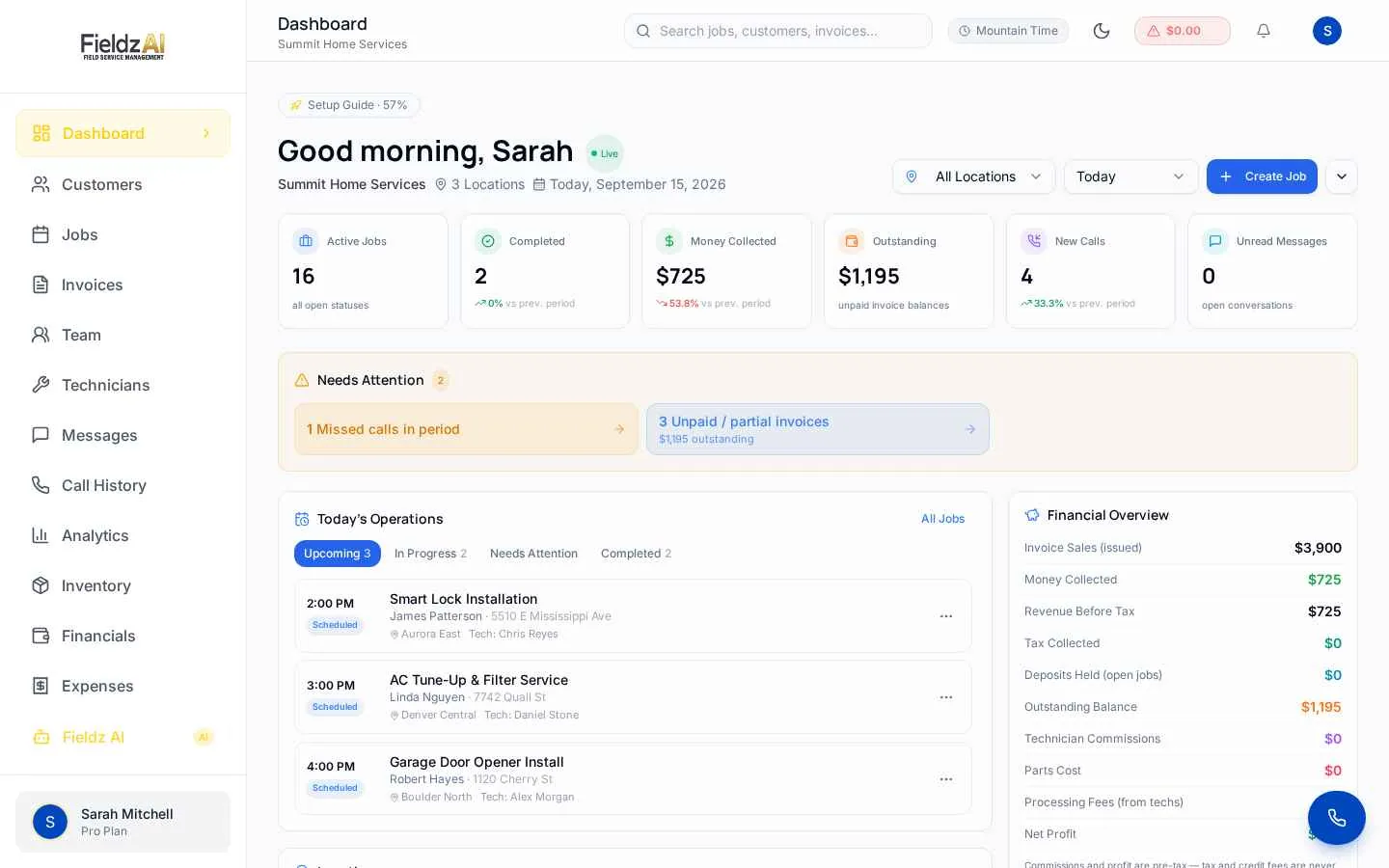
Weak financial reporting is the most common regret cited by switchers. Verify the platform can answer: what did this job net after parts, commissions, and card fees? What do I owe each technician right now? Is sales tax tracked separately or silently inflating revenue? If the demo can't show job-level profit, your accountant will be rebuilding it in spreadsheets forever.
Run a real trial
Free trials are only useful if you run real work through them. Import a slice of customers, book actual jobs for a week, send real invoices, and have one technician live on the mobile app. Pay attention to how often you have to leave the platform to finish a task — every exit is a seam where data and time leak.
Finally, test support before you're a customer: send a question mid-trial and see how fast and how competently it's answered. That experience predicts the relationship better than any sales call.
Key takeaways
- Evaluate against your five most common workflows, not feature checklists
- Price the platform with phone, SMS, and portals included — not the teaser tier
- Demand job-level profit reporting; weak money math is the #1 switcher regret
Free download
Get the Field Service Pricing Guide
The 4 pricing models vendors use, a hidden-cost checklist, and a worksheet to calculate any platform's true monthly cost.
Instant download. No spam — unsubscribe anytime.